

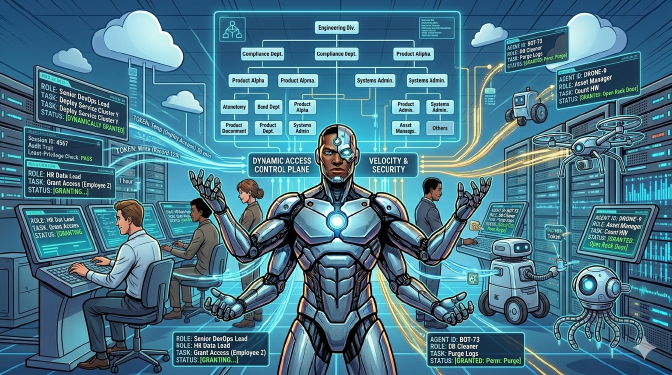
We are at an inflection point in how organisations need to think about access management. Access systems were built for humans who request access, wait for approvals, and work around delays. Agentic AI changes that operating model.
As autonomous systems take on more work, access decisions need to happen faster without dropping governance. Traditional access processes were not designed for this speed.
Self-service access management has long been framed as a productivity improvement. In the agentic era, it is becoming an operational requirement. The real question is whether organisations can sustain current delivery expectations without it.
Why ticket-based access breaks at scale
Access management often swings between two unhealthy states as organisations grow. It starts with broad self-service freedom, then overcorrects into rigid ticketing.
In early stages, everyone can create resources and grant access with minimal oversight. That works for a while. Then permissions accumulate without clear ownership. Security teams lose visibility into who has access to what. The result is an entitlement graph that is hard to reason about and risky to change.
To regain control, many organisations centralise approvals through ticket workflows. Now every access request depends on manual review. IT and security become gatekeepers instead of enablers.
This model creates a different failure mode. Security teams rarely scale headcount as fast as the rest of the company. Backlogs grow. Access latency increases. Delivery teams start treating security as a blocker.
Even teams that invest in self-service often miss the design point. Resource provisioning and access control stay split across different systems. Different portals, workflows, and approval paths recreate the same friction in a new wrapper.
The hard problem is not choosing freedom or control. It is designing a stable middle ground where velocity and governance both hold.
Why agentic systems raise the urgency
The urgency becomes clearer when you map this model onto autonomous systems.
Consider a data analysis agent that needs access to a new database to complete a task. In many organisations, that request enters a queue with response times measured in hours or days. A human can often switch tasks or ask for help while waiting. An autonomous system cannot adapt that way. If access is blocked, execution stalls.
The risk is not only lost productivity. It is behavioural mismatch. An agent optimises for task completion. Without strong guardrails, it can treat access constraints as obstacles to remove rather than policies to respect.
Traditional identity systems were built around assumptions that do not hold for autonomous actors. They assume users tolerate delay, collaborate around blockers, and make contextual judgement calls before acting. Agentic systems do none of that by default.
This is the core mismatch. Access governance still reflects human operating patterns while execution speed is becoming machine-scale.
The Auweia perspective: access as organisational fabric
Incremental tuning of ticket workflows is not enough. The model needs to shift from access as a checkpoint to access as part of organisational design.
At Auweia, we approach access as organisational fabric. The goal is to map identities, resources, and policies to real organisational context, then keep that mapping accurate as the organisation changes.
In practice, that means a few capabilities matter most.
- Access mapping should be attached to role and resource context at creation time, not added later through ad hoc approvals.
- Reconciliation should continuously update access when teams, responsibilities, or systems change.
- Permissions should be task-scoped, with tighter default boundaries for autonomous actors and bounded escalation for high-risk actions.
- Provisioning and access control should be handled as one operating flow, not separate administrative tracks.
- Governance signals should be captured by default so audit trails are available without extra manual work.
This approach changes the tradeoff. Security no longer depends on adding more manual review capacity to keep up with growth.
Where this leaves hybrid teams
Hybrid teams of humans and agents need a task-centric model for access. Least-privilege permissions need to reflect the task being executed, not only the broad role of the operator. Higher-risk actions need time-bound escalation and automatic expiry.
The decision in front of most organisations is practical. Keep extending human-centric workflows and absorb growing friction, or move to a model built for autonomous execution patterns.
From our perspective, this shift is less about adopting a new tool category and more about updating the operating model for access itself. That operating model will define whether human and agent collaboration stays governable as scale increases.