

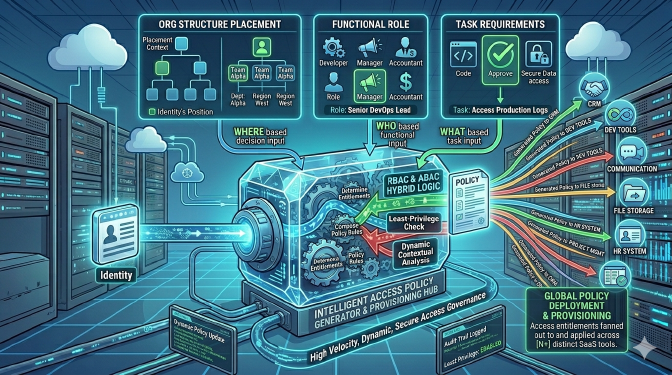
Organizational structure has meaning. It shapes how decisions flow, who has authority, and how quickly change can happen. When you layer agentic AI on top of an existing organizational model, the fit is either natural or can turn deeply awkward.
Many teams treat AI adoption as a technology problem. But it is also very much an organizational problem. The structure you have determines which access models work, which approval patterns break, and whether agents become accelerators or bottlenecks.
How the common organizational types handle agents
Organizational structures cluster into a few familiar patterns. Each makes different assumptions about delegation, decision-making speed, and who owns what. Underneath all of them is the same question: how do you deliver self-service speed while maintaining the oversight that security and privacy require? That tension is not new. But agentic AI gives it a new urgency, because agents act quickly, continuously, and across boundaries that were drawn for slower human work. Finding an effective balance at agentic speed is the crux, and the right place to start is the structure you already have. Structure is one axis; how an agent sits relative to people is another, and the two interact.
Flat organizations
Flat organizations distribute decision-making widely, with few approval layers between people and outcomes. Agents seem to fit naturally here, because fast and distributed action is already the norm. This looks like the natural home for what is likely the most common arrangement today, one or more agents working for an individual, since people here already act with little gatekeeping. The risk is that the same freedom turns into access sprawl, since agents move fast and have no natural brakes. The speed is already there; what is missing is policy expressed clearly enough to act as a guardrail.
Functional organizations
Functional organizations group people by expertise, with clear boundaries and a leader for each function. That gives strong ownership and natural enforcement points, but work that crosses functions has to move through handoffs. This is not a new problem. A human data analyst who needs database access already runs into it, with the data owned by engineering and provisioning controlled by operations. The difference is that a person copes by collaborating: asking around, finding the right owner, and waiting it out. Agents are not there yet. Because of LLM hallucinations and the harnesses they run inside, agents are often held to a narrower, more controlled communication path, which keeps them from improvising actions that look reasonable in theory but go wrong in practice. So a boundary that only slows a human could stall an agent completely.
Divisional organizations
Divisional organizations run as semi-autonomous business units, each with its own P&L. Agents appear to operate easily inside a division but fragment across them, because there is little incentive to share infrastructure. Each division tends to deploy its own agents for similar work, with no company-level view of who those agents are. Within a single unit, an agent often serves the whole team as shared support rather than one person, which only stays manageable when the unit names a clear owner for it. Local control is good; consolidated governance is missing.
Matrix organizations
Matrix organizations layer functional expertise over business units and are built for crossing boundaries. Agents seem to move freely, because the model already assumes people do. The cost is that nobody owns anything cleanly, so when an agent misfires or its access is misconfigured, accountability and forensics may fall between the cracks.
Network organizations
Network organizations replace permanent reporting lines with dynamic project allocation, forming teams around outcomes rather than org charts. Agents seem to fit naturally here too, because autonomous execution is already expected. It is also where an agent is most likely to join a project team as another member, an n+1 on the roster. But without stable roles and clear ownership records, access becomes nearly impossible to audit, and governance has to be designed in deliberately.
The lesson that connects them
The lesson across all five is the same. You cannot transplant a generic access framework onto an organization and expect it to hold. Access governance has to align with the shape the organization already has, because that shape is what tells you where speed should be free and where oversight has to sit. Each structure draws a boundary that matches how it divides itself, then has to govern access within that boundary at agentic speed. Getting that balance right is what turns agents into a productivity gain instead of a new source of risk.
A model that adapts to the structure you have
How to get this balance right, is at the core of what we have been working on at Auweia. So take this as a snapshot of our current thinking. Our working assumption is that access should be modeled on the organization as it actually operates, not on a separate access hierarchy that drifts away from it over time.
The building blocks are deliberately ordinary. A Tenant represents the organization itself. Identity Sources connect to the identity providers the organization already has, so the existing IdP stays the source of truth for identities, both human and non-human. Subjects are those identities once they are present in the system. Workspaces group work, and they are flexible by design: one per team, one per project, one per business unit, whatever matches how the organization is actually divided. Resources are the target services that access is granted to. Access Packages are where access is decided.
The connective tissue is labels. Identities arrive from the identity provider carrying metadata such as department, team, role, location, or project. Those attributes become labels on the Subject. Resources carry labels too, describing what they are and who owns them. An Access Package uses label selectors to find the relevant identities and the relevant resources, and grants access between them.
The first place the organizational type shows up is in how Workspaces are used. A divisional organization might lean toward a Workspace per business unit. A functional organization might prefer one per function. A network organization might spin one up per project. These seem like the natural fits, but they are not the only options, and mixed or in-between arrangements are easy to imagine, such as a Workspace per business unit subdivided by function underneath. That placement is not just tidiness on an org chart. It settles a tradeoff that self-service otherwise leaves open. On the one hand, self-service exists so work can move at the pace of the people doing it, without routing every request through a central queue. On the other hand, some oversight is not optional, because security and privacy obligations do not disappear when access gets faster. The Workspace is a natural place to draw the line between the two. IT or security own the boundary of the Workspace: which identities are eligible to be granted anything inside it at all. Members own what happens within it: granting access quickly among the resources and identities that already belong there.
In practice both the boundary and the matching inside it are the same kind of label constraint. The difference is where the selector comes from and who controls it. A Workspace carries a label selector set by IT or security, for example one that admits only identities whose business unit matches the Workspace. Every Access Package created inside that Workspace automatically inherits this selector, and members cannot remove or loosen it. Because label selectors are cumulative, a member’s own selector can only narrow the set further, never widen it past the Workspace boundary. That is what makes the pre-filtering hold: the people and agents available for access are always a subset of those the Workspace already admits. This is the guardrail security have been missing, because they set it once, at the level where the Workspace sits, and self-service then operates within it rather than against it. One direction we are exploring is inheritance, where a Workspace draws its scoping constraints from potentially multiple parents, so the boundary narrows naturally as you move deeper into the hierarchy.
An example makes the value concrete. Consider a Legal team responsible for employment contracts. Those documents cannot be exposed to just any identity in the company, and self-service must be guarded against becoming a way around that. If the Legal Workspace is scoped so that access can only be granted to identities whose function attribute is set to Legal at the identity provider, the constraint holds no matter who is configuring the access. An engineer cannot be added by mistake. An agent built to support a different team cannot be selected into a contract-handling Access Package, because it does not carry the required attribute. The sensitive boundary is enforced by the shape of the organization and where in the hierarchy the Workspace is located, not by the attention of whoever happens to be granting access that day.
Our first instinct, and we are still exploring this, is that each structure tends to have one decision point that matters more than the rest. In a functional organization that might be the function. In a divisional organization, the business unit. In a matrix organization, the assigned owner. In a network organization, the active project. These are the candidates that come to mind first, and they may well hold, but we would not present them as settled. If the label that captures that decision point is present and accurate, an Access Package can express the access rule in the organization’s own terms. The same mechanism adapts across structures, because the only thing that changes is which label does the selecting. A flat organization, a strict functional hierarchy, and a shifting network of project teams can all run on the same machinery with different labels.
The real flexibility shows up when selectors combine more than one label. A single label answers a single question. A combination can describe an access pattern that mirrors how the organization actually wants to work.
Take internal collaboration as an example. Resources can carry a visibility label, and a repository meant for open internal contribution can be marked innersource. Subjects carry a function label from the identity provider, so engineers are marked accordingly. An Access Package can then say that every subject whose function is engineer gets read and comment access to any resource whose visibility is innersource. The rule is written once, in the organization’s own terms, and it keeps applying as people join and repositories are created, without anyone maintaining a list.
Combinations also let a single boundary hold several roles at once. Suppose everyone inside a namespace should get read-only access to its resources, but the right to manage them should depend on who you are. A subject whose function matches and whose subject type is employee could be granted the manage role, while a subject with the same function whose subject type is contractor is held to the contributor role. For an organization that needs to limit what contractors can do, that distinction is expressed directly in the access rule rather than enforced by hand.
The point is that access is granted on a combination of labels drawn from the org structure and the metadata already attached to identities and resources. The more faithfully those labels describe the organization, the more precisely access can follow it.
There is an honest dependency in this. Label selectors are only as good as the labels behind them. If the metadata coming from the identity provider is incomplete, inconsistent, or out of date, the selectors inherit every one of those flaws. We think this is one of the places where AI is genuinely useful, less as a headline and more as a practical tool: surfacing which attributes already exist across sources, reconciling the ones that mean the same thing under different names, and flagging entries that look obsolete. The first payoff is a clearer view of the organization. Accurate access is what follows from that.
Where this leaves us
Organizational structure is not a backdrop to access control. The two are closer than they are usually treated: organizational design and identity governance are really two views of the same problem. Each structure draws its own boundary and carries its own decision points, and agentic AI raises the stakes by acting fast, continuously, and across lines drawn for slower human work.
The thread running through our approach is labels. A Workspace boundary set by IT, a Package’s own selector within it, and access rules built from combinations of identity and resource metadata are the same mechanism at different scopes. Get the labels right, and access can follow the organization as it actually is, and keep following it as it changes.
We are sharing this because it is how we currently think about the problem, not because it is finished. The mapping from structure to decision point, the inheritance of constraints down a hierarchy, and the role of AI in keeping metadata honest are all directions we are still exploring. What we are more confident about is the shape of the question. Balancing speed against security and privacy, now at agentic speed, is the part that will not go away.
If you are working through the same problem in your own organization, we would like to hear how your structure shapes it. The right model will come from that conversation as much as from us.